

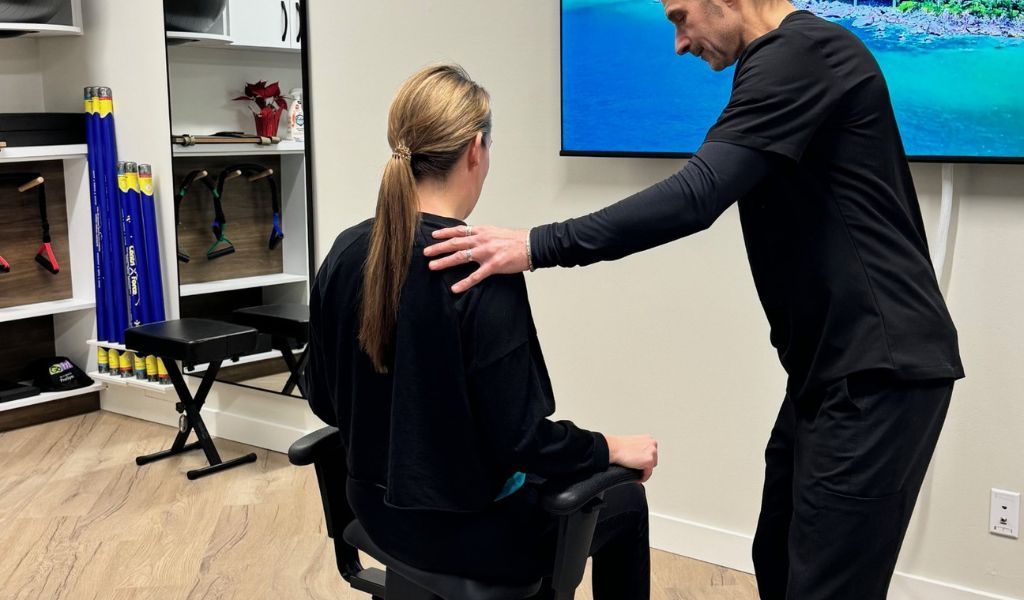
Patients ask me some version of this question almost every visit: "Why do I feel great walking out of here, and then two days later I'm right back to hunching over my laptop?" The honest answer is that an adjustment restores motion to a joint that was restricted and reduces the muscle guarding and pain that came with it, but your body doesn't just decide to stay corrected. Muscles, tendons, and the connective tissue around a joint have a memory for whatever position you put them in the most, and if that position is still slouched at a desk for eight hours a day, they will pull you right back toward it.
That's what the home routine is for. It's not a substitute for care at rehab exercise therapy visits, it's the piece that makes the correction stick between them. Below is close to the actual 10-minute routine I give patients who are working on posture, and the reasoning behind each part, so you understand what it's doing rather than just going through the motions.
Why "Just Sit Up Straighter" Doesn't Work
Telling yourself to sit up straight fixes your posture for about ninety seconds. The muscles that hold you upright - the deep neck flexors, the mid-back extensors, the muscles between your shoulder blades - are usually weak and fatigue fast in people who sit most of the day, while the muscles that pull you forward (chest, front of the shoulders, upper traps) are short and overactive. Willpower can't out-argue that muscle imbalance for long. You have to actually rebalance it, which means strengthening the weak side and loosening the tight side on purpose.
The Routine
1. Chin tucks - 2 sets of 10
Sit or stand tall, then glide your chin straight back like you're making a double chin, without tipping your head down. Hold two seconds, release. This retrains the deep neck flexors that forward head posture (the position most desk and phone use puts you in) leaves inhibited - weak and slow to activate.
2. Doorway chest stretch - 3 x 20 seconds per side
Forearm on a doorframe, elbow at shoulder height, gently lean your body through the doorway until you feel a stretch across the front of the shoulder and chest. This is the tight side of the imbalance, and it's usually the one people neglect because it doesn't feel productive the way a strengthening exercise does.
3. Prone Y-raises - 2 sets of 12
Lie face down, arms out in a Y shape, thumbs up. Lift your arms a few inches off the floor, squeezing the muscles between your shoulder blades, then lower slowly. This is the weak side - the mid and lower trapezius - and it's the muscle group most responsible for keeping your shoulders from rolling forward.
4. Wall angels - 2 sets of 10
Back flat against a wall, arms bent at 90 degrees against the wall like a goal-post. Slide your arms up and down while keeping your forearms and lower back in contact with the wall. This combines the stretch and the strengthening piece in one movement and exposes exactly where your range of motion is still limited.
5. Standing thoracic extension over a chair back - 30 seconds
Hands behind your head, upper back against the top of a sturdy chair, gently arch backward over it. Most people carry the bulk of their forward slump in the mid-back, and this single stretch does more to reverse it than almost anything else on this list.
We have short video demonstrations of all five in our exercise video library if you'd rather watch than read a description. Several of these same principles are built into the assessment we run at PostureZone, which is where we measure whether the imbalance is actually improving rather than guessing from how you feel.
Where This Fits With Your Care Plan
This routine is not a replacement for structural correction through chiropractic adjustments when there's an actual misalignment causing the postural collapse in the first place - it's the maintenance work that protects the gains from those visits. Think of the adjustment as resetting the position and the home routine as convincing your body that the new position is the one worth keeping. Patients who skip the home piece tend to plateau faster and need more frequent adjustments just to maintain ground, which is more time and cost than most people want to spend.
The keyword that gets searched most often around this topic is "posture correction exercises," and for good reason - posture is one of the few things about how your spine feels day to day that you have direct, daily control over. The CDC's physical activity guidelines note that strengthening the major muscle groups at least twice a week supports the same postural and musculoskeletal health this routine targets (CDC, Physical Activity Basics). The National Institute of Arthritis and Musculoskeletal and Skin Diseases has a similar summary specific to back-supporting exercise for people managing chronic back discomfort (NIAMS, Back Pain).
What to Do If It's Not Enough
Some patients do this routine faithfully and still feel like they're fighting an uphill battle. That's usually a sign there's a structural component - a joint that's actually restricted, not just weak muscles around it - that exercise alone won't resolve. That's exactly the kind of thing we look for with testing before we ever adjust anyone, rather than assuming every case is the same. If the ten minutes above haven't moved the needle after a few weeks, that's worth bringing up at your next visit, or you can book an appointment to have it assessed directly.
For more on what happens at that first visit, see our related posts on standing desks and the truth about posture and backpack fit and posture in kids. If your posture problems are tangled up with ongoing pain rather than just tightness, this piece on mobility and aging covers the related mechanism.