Picture a school gym in the early 2000s. A nurse has the class bend forward one at a time, glances at each back, and moves on. You hear "a little curve, nothing to worry about," a letter goes home, and that is the last anyone mentions it. Twenty years later you are sitting at a desk in Renton with an ache along one side of your back, and that old comment suddenly comes to mind.
This is a common story, and it is a fair question. Does a mild curve from your teens still matter as an adult? The honest answer is that it depends, and the way to find out is a proper look rather than a guess.
What scoliosis means in an adult
Scoliosis is a sideways curve of the spine, often with some rotation of the vertebrae. In teens, the cause is usually unknown. In adults, there are two broad situations.
The first is a curve that began in adolescence and carried into adulthood. Many of these stay quiet for years. The second is a curve that develops later in life as the discs and small joints of the spine wear unevenly, sometimes called degenerative scoliosis. Both can show up in people who have never had a day of back trouble, and both can be found by accident on an X-ray ordered for something else.
The National Institute of Arthritis and Musculoskeletal and Skin Diseases offers a plain-language overview of scoliosis in children and adults if you want background reading from a government source.
A curve on its own is not a diagnosis of a problem. What matters is whether it is changing, whether it is causing symptoms, and how the rest of the spine and hips are coping with it.
Signs worth noticing as an adult
Adults rarely notice a curve the way a parent might notice an uneven shoulder on a teen. These are the things people more often mention at a first visit:
- One shoulder or hip that looks or feels higher than the other
- A waistline that seems uneven, or clothes that hang differently on one side
- A shoulder blade that sticks out more on one side
- Low back or mid-back aching that settles on one side and builds toward the end of the day
- Stiffness that makes it harder to stand tall or walk for long stretches
- Leg tingling, numbness or heaviness, especially with standing or walking
None of these proves scoliosis. Plenty of people with a perfectly straight spine have an uneven shoulder, and plenty of people with a curve have no symptoms at all. They are simply reasons to have the spine looked at carefully.
Why a teen curve is worth a second look
Spines change as we age. Discs lose some height, joints stiffen, and the muscles that hold us upright get less exercise if we sit most of the day. A curve that was small at fifteen sits in a different spine at forty-five or sixty-five, and the way it loads the joints can change with it.
That does not mean the curve has grown or that anything is wrong. It means an old note in a school file is not a current picture. If you have never had an adult exam, or you had one a long time ago, a fresh baseline gives you something to compare against later. Our article on scoliosis screening in teens covers how curves are first found, which can help you make sense of what you were told back then.
What a testing-first visit looks like
At Lakeside Spine and Wellness, we start with your story: when the curve was found, what you were told, what you feel now, and what your work and weekends demand of your back. Then we examine how you stand, move and bend, look at the alignment of the shoulders, ribs and pelvis, and check strength, reflexes and sensation when your history calls for it.
When it is appropriate, imaging helps give a clearer picture of the spine itself. Our approach to Chiropractic BioPhysics (CBP) is built around a thorough exam and, when appropriate, imaging, so that any plan is based on what your spine is actually doing rather than on assumptions.
If the findings point to something that needs a medical specialist, such as a curve that is progressing, nerve symptoms that are getting worse, or signs the problem is not coming from the spine, we refer you promptly. Our scoliosis page explains how we think about curves and what we look at.
What care can and cannot do
This part deserves plain talk. Chiropractic care is not a way to straighten a structural curve, and anyone who promises that should be treated with caution. What we can do is look at how the spine and surrounding tissues are moving, and where chiropractic care is appropriate, use gentle adjustments, movement guidance and exercise to support comfort and function around the curve.
Many adults with scoliosis find that strengthening the trunk and hips, keeping the spine moving and breaking up long stretches of sitting make a noticeable difference in how the day feels. We cannot promise an outcome, and each person responds differently. Care is shaped around your exam findings and your goals, and it works alongside any monitoring or treatment your medical doctor recommends.
When to get checked sooner
Book an evaluation if you notice any of these:
- A visible change in how your shoulders, ribs or waist line up
- Back pain that is steadily getting worse or waking you at night
- Numbness, tingling or weakness in the legs
- Trouble standing upright or walking as far as you used to
- A family history of scoliosis and a back that has never been examined
Seek emergency care right away for sudden loss of bladder or bowel control, numbness in the groin area, or sudden severe weakness in the legs. Chest pain or trouble breathing also needs urgent medical attention.
Frequently asked questions
I had a mild curve as a teen. Should I be worried?
Not necessarily. Many mild curves stay stable and cause no trouble. A current exam gives you a clear picture instead of leaving the question open.
Can scoliosis start in adulthood?
Yes. Uneven wear of the discs and joints can create a curve later in life. This is different from the adolescent type, though the two can look similar on an X-ray.
Do I need an X-ray?
Not always. Whether imaging makes sense depends on your history, your symptoms and what the exam shows. We discuss that with you at the visit.
Ready for a clear answer
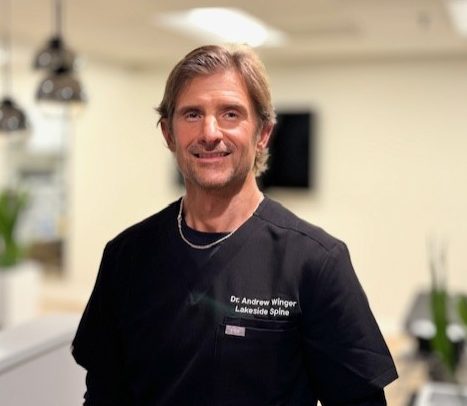
If an old curve has been on your mind, or your back has started to tell you something, a testing-first exam can replace the guesswork. New patients start with a $59 New Patient Special, including a full consultation and exam. Call (425) 276-8044 or book your first visit online with Dr. Andrew Winger at Lakeside Spine and Wellness in Renton.