

Ask most people where their back hurts and they point low. But a steady share of the people who walk into our Renton office point somewhere else: the spot between the shoulder blades, a deep ache or tight band that builds through the workday and never quite lets go. The mid-back, known as the thoracic spine, gets far less attention than the neck or lower back, even though it connects to both.
Why the Mid-Back Gets Stiff
The thoracic spine is built differently from the rest of the spine. Each vertebra connects to a pair of ribs, which makes this region sturdier and less flexible by design. That stability is useful, but it also means that when this area loses motion, the neighbors compensate. The neck and lower back are meant to move more, and when the mid-back stiffens, they often take on extra work.
Long hours in a forward-leaning position are a common contributor. Looking down at a phone, leaning toward a monitor, or driving with your shoulders rounded all encourage the upper back to settle into a curved posture. Over weeks, muscles between and around the shoulder blades can stay under constant low-level tension, and the small joints where the ribs meet the spine can become irritated and restricted.
What People Describe
Mid-back discomfort does not feel the same for everyone. Common descriptions include:
- A dull ache or burning sensation between the shoulder blades
- A sharp catch when taking a deep breath or twisting
- Stiffness when reaching overhead or behind you
- Tightness that wraps toward the ribs
- Discomfort that is worse after sitting and eases with movement
Several of these overlap with other problems, which is why a proper evaluation matters. Pain that comes with chest pressure, shortness of breath, pain spreading to the jaw or arm, or any sudden severe onset is not a chiropractic question. Those symptoms need urgent medical attention, so call 911 or go to an emergency room.
Where the Neck Fits In
A surprising amount of upper-back pain starts higher. Irritated joints and muscles in the lower neck can refer discomfort into the area between the shoulder blades. If you also notice stiffness when turning your head or tension at the base of the skull, the neck is worth examining alongside the mid-back. We explain that overlap in more detail on our neck pain page, and the posture side of the story in our article on standing desks and posture.
What a Testing-First Visit Looks Like
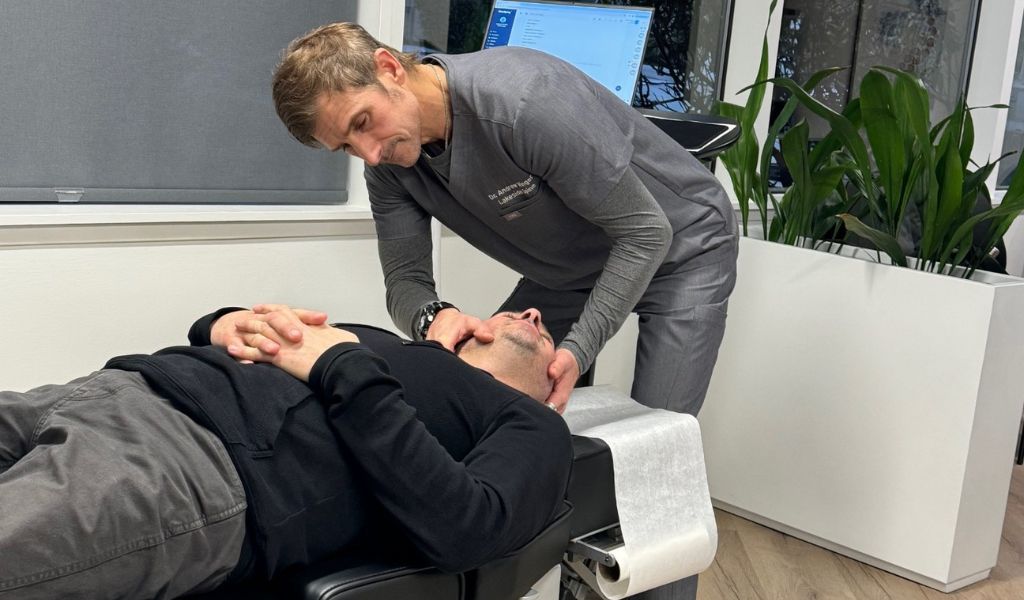
At Lakeside Spine and Wellness, care starts with listening and testing. We look at how your spine and rib cage move, how you stand and sit, and which movements reproduce your symptoms. The goal is to identify what is restricted, what is overworking, and what daily habits keep feeding the pattern. If your findings suggest chiropractic care is appropriate, we explain the plan before starting. If something looks like it needs a different kind of provider, we say so.
Care can include gentle adjustments to restricted areas of the spine, along with simple movement and posture guidance you can use at home. Our rehab and exercise therapy service covers the strengthening and mobility work that helps keep results from fading between visits. No visit can promise a specific outcome, and every patient responds differently.
Small Habits Worth Trying
While you decide whether to come in, these low-risk changes are worth a try:
- Raise your screen so the top sits near eye level.
- Stand up and reach overhead every 30 to 45 minutes.
- Support your lower back in the chair so the upper back is not doing all the holding.
- Spread your hands on a doorway frame and gently lean through to open the chest.
- Pay attention to how you carry bags and laptops, and alternate sides.
Frequently Asked Questions
Why does the pain between my shoulder blades get worse at my desk?
Hours of sitting with the head forward and shoulders rounded keep the muscles around the shoulder blades under steady tension. Without regular breaks and position changes, that tension tends to build through the day.
Can neck problems cause pain between the shoulder blades?
Yes. Joints and muscles in the lower neck can refer discomfort into the upper back. That is why we check the neck and mid-back together instead of treating the sore spot in isolation.
When should mid-back pain be checked right away?
Pain with chest pressure, trouble breathing, pain moving into the jaw or arm, fever, or a sudden severe start needs emergency medical care. Persistent aching that does not ease after a week or two is a good reason to schedule an evaluation.
What to Do Next
If an ache between your shoulder blades keeps coming back, it is worth finding out why instead of working around it. New patients start with a $59 New Patient Special, including a full consultation and exam. Call (425) 276-8044 or book your first visit online with Dr. Andrew Winger at Lakeside Spine and Wellness in Renton.
References
- National Institute of Arthritis and Musculoskeletal and Skin Diseases, Back Pain
- American Academy of Orthopaedic Surgeons, OrthoInfo: Neck and Back Conditions